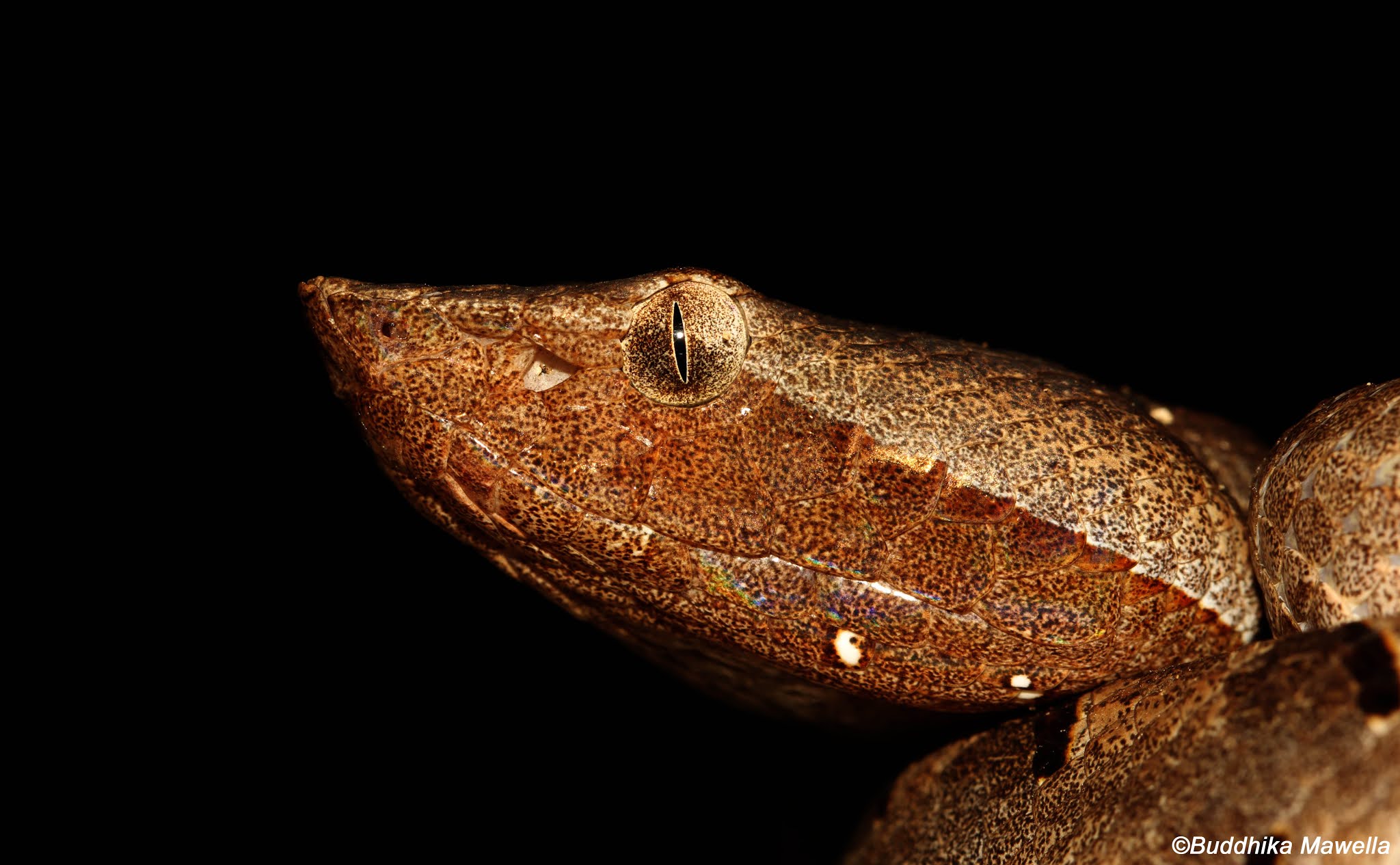
English: Merrem's hump-nosed viper
Sinhala: කුණකටුවා / පොලොන් තෙලිස්සා [Kunakatuwua/Polon thelissa]
Binomial name: Hypnale hypnale
Hypnale hypnale (Merrem's hump-nosed viper) is a venomous pit viper species found in Sri Lanka and India. Based on the taxonomic revisions done so far, have stated that there are four species that belong to the genus Hypnale which live in Sri Lanka (Including possibly new species Hypnale sp. ‘amal’). Among them, population of H. hypnale in Sri Lanka has been observed mainly in anthropogenic habitats and no observations have been made in undisturbed forests (Maduwage et al. 2009). At a glance, morphologically all these four species look similar. But with a closer look, H. hypnale can be easily distinguished from its congeners using scalation and with the help of non raised snout tip. This species is more active at night and in the day time they live under the logs, rocks and in the leaf litter. Venom of this genus mainly causes local envenoming, coagulopathy, acute renal failure and death. A research done by Dr. Anjana Silva and others (Silva et al. 2012) to compare the in-vivo toxicity of venoms of this genus reveals that the venom of H. hypnale has the highest toxicity compared to the venom of H. zara and H. nepa, with the LD50 value of 1.6 μg protein/g. Since there are known human bite reports with serious complications, this snake has been placed in the category of ‘Medically important’.
Ref:
Silva, Anjana, Panduka Gunawardena, Danister Weilgama, Kalana Maduwage, and Indika Gawarammana 2012 Comparative in-Vivo Toxicity of Venoms from South Asian Hump-Nosed Pit Vipers (Viperidae: Crotalinae: Hypnale). BMC Research Notes 5(1): 471.
Maduwage, Kalana, Anjana Silva, Kelum Manamendra-Arachchi, and Rohan Pethiyagoda 2009 A Taxonomic Revision of the South Asian Hump-Nosed Pit Vipers (Squamata: Viperidae: Hypnale). Zootaxa 2232: 1–28.
Maduwage K, Kularatne K, Wazil A, Gawarammana I: Coagulopthy, acute kidney injury and death following Hypnale zara envenoming – The first case report from Sri Lanka. Toxicon 2011, 58:641–643


 Henckelia angusta is an endemic herb found on rocky surfaces of shady sreams. It has been restricted to lowland forests of southwestern part of Sri Lanka.