Showing posts with label Amphibians. Show all posts

Sunday, September 8, 2024

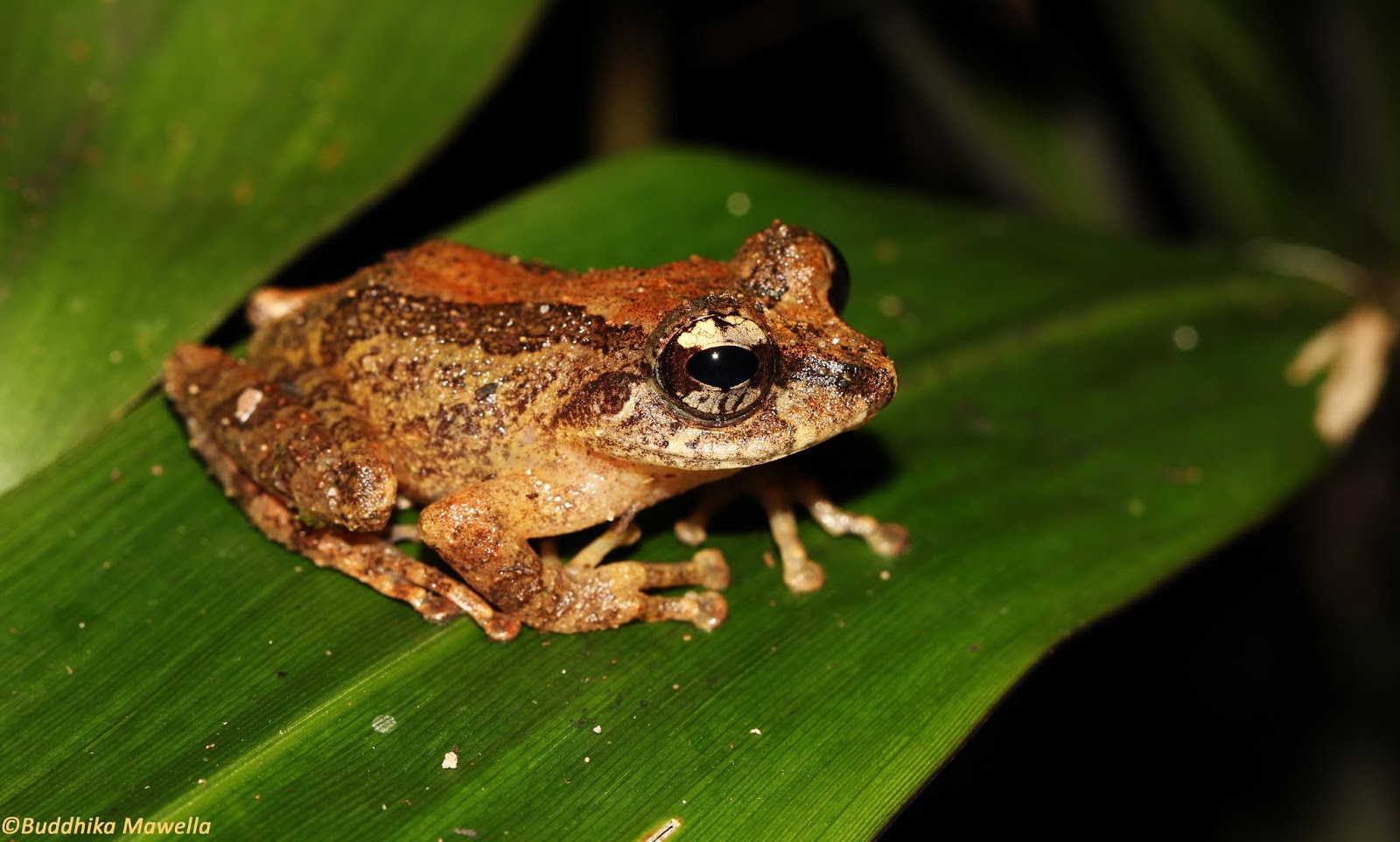
Pseudophilautus jagathgunawardanai

Pseudophilautus jagathgunawardanai (ජගත් ගුනවර්දනගේ පදුරැ මැඩියා) is an endemic species of shrub frog restricted to the Sripada Peak.

Saturday, May 23, 2020

Rohan’s Globular Frog (Uperodon rohani)

English: Rohan’s Globular Frog
Sinhala: රොහාන්ගේ මොට හොඹු මැඩියා[Rohange motahombu madiya]
Binomial: Uperodon rohani
Taxonomic revision done in the genus Uperadon describes that previously known amphibian Uperodon variegatus of Sri Lanka as a new species and it was named as Uperadon rohani. Also it is said that this species is endemic to Sri Lanka. Species name ‘rohani’ has been used in honor of Mr. Rohan pethiyagoda, who is a popular naturalist in the country. Uperadon rohani differs from its close Indian relative Uperadon variegatus by a set of morphological characters. In addition to the morphology, genetic studies done in the research based on 16S mitochondrial RNA also proves the same.

Monday, April 13, 2020

Handapan ella shrub frog (Pseudophilautus lunatus)

English: Handapan ella shrub frog
Sinhala: හඳපාන් ඇල්ල පැදුරු මැඩියා[Handapan ella panduru madiya]
Binomial: Pseudophilautus lunatus 

Pseudophilautus lunatus was first described in 2005 using a specimen found in Hadapan Ella near Suriyakanda in the Eastern Sinharaja area. Species name ‘Lunatus’ has the meaning of ‘Moon’. The species-epithet lunatus derives from Lunar which is a Latin word for moon. That word alludes to the type locality (‘Handapan Ella’ = moonlit waterfall). In their research paper, the first two observers, Kelum Manamendra Arachchi and Rohan Pethiyagoda, have mentioned that the endemic P. lunatus specimen was first observed in a cloud forest at an elevation of 1270 m above the sea level. So this amphibian which is geographically confined to a very small area, can be considered as a species with a higher possibility of extinction.

Saturday, March 21, 2020

Dilmah shrub frog (Pseudophilautus dilmah)

English: Dumbara corrugated frog
Sinhala: ඩිල්මා පදුරු මැඩියා[Dilmah panduru madiya]
Binomial: Pseudophilautus dilmah

Lulkandura Estate, known as the first tea plantation of Sri Lanka was first established by Mr. James Taylor in 1867. Even though most of the natural forests in the Loolkandura were cut down for early tea cultivation long time ago, only a small portion of the original cover still exists. Small frog in below photos was first described from the same area Loolkandura by a team of researchers led by Mr. Mendis Wickramasinghe in 2015. Population of them has only been restricted to the remaining natural forest patches of Loolkadura. Also the newly discovered frog was given the name Dilmah shrub frog (Pseudophilautus dilmah, ඩිල්මා පදුරු මැඩියා). The species has been named after Dilmah, which is a world renowned Sri Lankan tea exporting company who has contributed to the research. The fragmentation of forests and the global warming can be considered as threats for this rare frog.
Reference:
Wickramasinghe, Mendis; Bandara, Imesh Nuwan; Vidanapathirana, Dulan Ranga; Tennakoon,Kamani; Samarakoon,Sameera; Wickramasinghe, Nethu (26 April 2015). "Pseudophilautus dilmah, a new species of shrub frog (Amphibia: Anura: Rhacophoridae) from a threatened habitat Loolkandura in Sri Lanka".

Sunday, August 25, 2019

Dumbara corrugated frog (Lankanectes pera)

English: Dumbara corrugated frog
Sinhala: දුම්බර වකරැලි මැඩියා [Dumbara wakareli madiya]
Binomial: Lankanectes pera
For more than 150 years, it was believed that the genus Lankanectes is monotypic and the genus consists of a one species named, Lankanectes corrugatus. But later, a group of researchers observed an amphibian in Knuckles mountains that was very similar to previously known L. corrugatus, but having some morphological differences. 
Finally in 2018, they have described the Lankanectes population resides in the knuckles mountain range as a new species by giving the name, Lankanectes pera. Species was named after University of Peradeniya and the name 'Pera' is a short form of the name for University of Peradeniya which is being used by many university students. 
Genetic studies have also been carried out to compare genetic differences between L. corrugatus and the knuckles population of Lankanectes. Results from DNA barcoding and phylogenetic analyses have shown that L. pera differs from L. corrugates by 3.5−3.7% uncorrected genetic distances for 16S rRNA, which is adequate to name the knuckles population as a separate species. Based on the study, they have concluded that the new species defers from L. corrugates in external morphology, genetics and climatic niche. 
Distribution of L. pera is very limited and they have been restricted to higher altitude streams flowing through the montane forests in the Knuckles region where elevation is about 1100m above the sea level. Also, the environments they live have already been threatened by human activities. Hence, some immediate conservation actions must be taken to protect this rare frog.
Referance:
Senevirathne, Gayani & Samarawickrama, Pradeep & Wijayathilaka, Nayana & Manameendraarchchi, Kelum & Samarawikrama, DRNS & Meegaskumbura, Madhava. (2018). A new frog species from rapidly dwindling cloud forest streams of Sri Lanka—Lankanectes pera (Anura, Nyctibatrachidae). Zootaxa. 4461. 519-538. 10.11646/zootaxa.4461.4.4.

Sunday, June 9, 2019

Mihintale Red Narrow-mouthed Frog (Microhyla mihintalei)

English: Mihintale Red Narrow-mouthed Frog
Sinhala: මිහින්තලය රතු මුව පටු මැඩියා [Mihinthalaya rathu muwa-patu madiya]
Binomial: Microhyla mihintalei

Mihintale Red Narrow-mouthed Frog(Microhyla mihintalei) is an endemic frog and it was described recently (2016) with the help of specimens collected from dry zone of Sri Lanka including Mihinthale. The species was named after Mihintale which is one of the world’s earliest documented sanctuaries. It is also known as the place where King Dewanampiya Tissa met Mihindu thero who came from India in 246 BC.
But the ancestors of Microhyla mihintalei have found their way to Sri Lankan lowlands from India few million years ago via the land bridge created between Sri Lanka and India which was caused by earlier ice ages followed by excessive ice deposits in poles. But later, rise in the sea level caused land mass between India and Sri Lanka to disappear by creating an oceanic barrier and that resulted closing the land connection between two lands.
In India, Still lives a frog named Microhyla rubra, who is considered to be a descendent of the common ancestor of Microhyla mihintalei. As a result of thousands of years of separation due to the oceanic barrier between two land masses, Sri Lankan population of this common frog has been evolved as the new species we call, Microhyla mihintalei.
Studies have suggested significant genetic distance, morphology and differences in vocalization to distinguish Microhyla mihintalei from its common Indian ancestral species, Microhyla rubra.

Reference:
Meegaskumbura, Madhava; Biju, S. D.; Karunarathna, Nuwan; Senevirathne, Gayani; Garg, Sonali; Wijayathilaka, Nayana (2016). "A new species of Microhyla (Anura: Microhylidae) from Sri Lanka: an integrative taxonomic approach". Zootaxa. 4066 (3): 331–342. doi:10.11646/zootaxa.4066.3.9

Saturday, June 3, 2017

Knuckles Shrub Frog (Pseudophilautus fulvus)


English: Knuckles Shrub Frog
Binomial: Pseudophilautus fulvus
Sinhala: දුම්බර පඳුරු මැඩියා

Pseudophilautus fulvus is an endemic species of shrub frogs restricted to the Knuckles mountain region. It has been observed in closed canopy forests, anthropogenic habitats, secondary forests and cardamom plantations(Meegaskumbura and Manamendra-Arachchi 2005).
Above photographed ones were observed in the adjoining forest of Deanston Conservation Center in the knuckles region. The major threats for the species are habitat destruction and agro-chemical pollution. IUCN Red List status of the frog is ‘Endangered’

References: 
  • Manamendra-Arachchi, K., and Pethiyagoda, R. (2005). ''The Sri Lankan shrub-frogs of the genus Philautus Gistel, 1848 (Ranidae: Rhacophorinae), with description of 27 new species.'' Raffles Bulletin of Zoology, Supplement 12, 163-303.
  • The IUCN Red List of Threatened Species(tm) 2015-4 - http://www.iucnredlist.org
  • Manamendra-Arachchi, K. & R. Pethiyagoda (2006): Sri Lankan amphibians [in Sinhala]. – WHT Publications, Colombo.

Sunday, February 26, 2017

Mittermeier's shrub frog (Pseudophilautus mittermeieri)

English: Mittermeier's shrub frog
Binomial: Pseudophilautus mittermeieri
Sinhala: මිටර්මයර්ගේ පඳුරු මැඩියා

Mittermeier's shrub frog is an endemic species of shrub frogs restricted to the lowland wet zone of Sri Lanka. According to the original description, they have been observed in Kottawa and Beraliya Forest, in Elpitiya at the elevation levels of 60m and 150m. This species is morphologically more similar to Pseudophilautus decoris and phylogenetic analysis also shows that they are more related. But the population of P. decoris has been restricted to the Rakwana mountains with a higher elevation level compared to the habitat of Pseudophilautus mittermeieri(Meegaskumbura and Manamendra-Arachchi 2005). 
Above photographed ones were observed in Gilimale and Makandawa (Kithulgala) wet zone rain forests that fall in to the same elevation range(60m-150m). They were observed on shrubs of the closed forest. IUCN red list status of the species is endangered (EN).

Referances:
  • Meegaskumbura, Madhava, and Kelum Manamendra-Arachchi 2005 Description of Eight New Species of Shrub Frogs (Ranidae: Rhacophorinae: Philautus) from Sri Lanka. The Raffles Bulletin of Zoology 12: 305–338.
  • The IUCN Red List of Threatened Species(tm) 2015-4 - http://www.iucnredlist.org
  • Manamendra-Arachchi, K. & R. Pethiyagoda (2006): Sri Lankan amphibians [in Sinhala]. – WHT Publications, Colombo

Friday, January 6, 2017

Stuart's shrub frog ( Pseudophilautus stuarti)

Color of this one has been changed to match with the leaf litter.
English: Stuart's shrub frog
Binomial: Pseudophilautus stuarti
Sinhala: ස්ටුවර්ට්ගේ පඳුරු මැඩියා

Philautus stuarti is an endemic species of amphibian restricted to the knuckles region of Sri Lanka. This species was first described from the Coberts Gap region of knuckles by Dr. Meegaskumbura and Mr. Kelum Manamendra-Archchi in 2005. Elevation above the sea level of their observed location was about 1245m (Meegaskumbura and Manamendra-Arachchi 2005).

This species occurs in cloud forests with a good canopy cover. There is a similar species of amphibian which lives in the same knuckles region, namely Pseudophilautus mooreorum with the same body color. But P. stuarti can be easily distinguished from P. mooreorum by the prominent supratympanic fold and sharp cathal edge.
In addition to that, a population of shrub frogs named Pseudophilautus viridis which is morphologically more similar to P. stuarti occurs in the central highlands of Sri Lanka. Phylogenetic analyses have revealed that these both species are genetically more related to each other. These two populations have been geographically separated by Mahaweli River valley that separates central hills from the knuckles mountain region(Meegaskumbura and Manamendra-Arachchi 2005). It is believed that this long term geographical separation has led to common ancestor species of frogs to divide into two geographical groups and then to evolve them as two new separate species namely P. viridis and P. stuarti.

Above photographed ones were also observed in the adjoining forest of Deanston Conservation Center in the knuckles region which is about 4 km away from the Coberts Gap. Observed location was at a height of about 1320m above the sea level. We can believe that the reminding conserved forest segments of knuckles region provides some protection for the species. But due to the limited distribution, it falls in to the category of ‘Endangered’ in the IUCN Red List.

Referances:
  • Meegaskumbura, Madhava, and Kelum Manamendra-Arachchi 2005 Description of Eight New Species of Shrub Frogs (Ranidae: Rhacophorinae: Philautus) from Sri Lanka. The Raffles Bulletin of Zoology 12: 305–338.
  • The IUCN Red List of Threatened Species(tm) 2015-4 - http://www.iucnredlist.org
  • Manamendra-Arachchi, K. & R. Pethiyagoda (2006): Sri Lankan amphibians [in Sinhala]. – WHT Publications, Colombo

Thursday, December 29, 2016

Half-webbed Pug-snout Frog (Uperodon palmatus)


English: Half-webbed Pug-snout Frog
Binomial: Uperodon palmatus/Ramanella palmata
Sinhala: පාකර්ගේ මොට හොඹු මැඩියා[Pakerge mota hombu madiya]

Half-webbed Pug-snout Frog is an endemic species of frogs restricted to the central highlands of Sri Lanka. Above photographed specimen was found close to a forest in Nuwaraeliya district and the elevation above sea level of the location was about 1894m. It is considered to be a rare species due to the limited distribution of the population. This frog is morphologically more similar to Uperodon obscurus. But the differences in webbed feet can be used to distinguish one form other.

Currently limited researches have been done related to the breeding biology of this species. According to those researches, Mr. Anaslem de Silva has reported that he has observed the tadpoles of this frog in phytothelms in Horton National Park (de Silva, 1999). In addition to that in a research done by Dr. Kanishka Ukuwela and others have reported that they have observed the tadpoles of this frog in rock pools close to a stream in Seetha Eliya(Ukuwela, Silva, and Athukorala 2010).

IUCN Red List status of this amphibian is 'Endangerd'. Agricultural activities, logging, forest dieback and droughts can be regarded as major threats for the species.

References:
  • De Silva, Anselm. 1999. The habitat preferences and the status of amphibians and reptiles at Horton Plains National Park. Report, Zoological Survey of Sri Lanka. National Science Foundation, Colombo. 67 pp.
  • Ukuwela, K. D. B., E. I. L. Silva, and N. P. Athukorala 2010 The Tadpole of Ramanella Palmata (Anura: Microhylidae), a Frog Endemic to Sri Lanka. Zootaxa 2628: 63–65.
  • The IUCN Red List of Threatened Species(tm) 2015-4 - http://www.iucnredlist.org
  • Manamendra-Arachchi, K. & R. Pethiyagoda (2006): Sri Lankan amphibians [in Sinhala]. – WHT Publications, Colombo

Saturday, November 5, 2016

Bigfoot shrub frogs (Pseudophilautus macropus)


English: Bigfoot shrub frogs
Binomial: Pseudophilautus macropus
Sinhala: විශාල පාදැති පඳුරු මැඩියා [Wishala padathi panduru madiya]

Pseudophilautus macropus is an endemic species of shrug frogs restricted to the Knuckles region of Sri Lanka. This frog is normally found near the streams and on wet rock surfaces. It is morphologically more similar to Pseudophilautus sarasinorum. Due to the limited habitat distribution, it is in the category of  'Critically Endagered'.

References: 
  • The IUCN Red List of Threatened Species(tm) 2015-4 - http://www.iucnredlist.org 
  • Manamendra-Arachchi, K. & R. Pethiyagoda (2006): Sri Lankan amphibians [in Sinhala]. – WHT Publications, Colombo.

Saturday, October 1, 2016

Kotagama's toad (Duttaphrynus kotagamai)

Parietal ridges and parotid glands are not much visible in a juvenile

English: Kotagama's toad
Binomial: Duttaphrynus kotagamai/Bufo kotagamai
Sinhala: කොටගමගේ ගෙම්බා[Kotagamage gemba]

Kotagama's toad is an endemic species of frogs found in Sri Lanka. It is nocturnal and lives in covered forests where there is a good canopy layer. Species name of the frog, ‘Kotagamai’ is a patronym honouring Prof. Sarath Kotagama.
Adults of this species can be easily distinguished from other members of Bufonidae family found in Sri Lanka by the prominent inwardly-curved parietal ridges of the head. In a research done by Dr. Prithiviraj Fernando and others (Fernando & Dayawansa, 1994) it is mentioned that the species can be observed on rocky margins of streams, sand banks, vicinity of streams and in the leaf litter of the forest. In the research paper they have mentioned that Sinharaja, Kithulgala and Massana rain forest for distributed locations.

Above photographed ones were also observed in the leaf litter at the Makandawa rain forest, Kithulgala in March and December of 2015. We did not observe any streams very close to the observed location and believed that they have moved to that location from a nearby stream after the metamorphosis. In the IUCN Red List it is in the category of ‘Endangerd’. Habitat loss and human disturbances are said to be the major threat for the existence of this species.

Referances:
  • Bufo kotagamai, a new toad (Bufonidae) from Sri Lanka P Fernando, N Dayawansa, M SIRIWARDENA Journal of South Asian natural History 1 (1), 119-124
  • The IUCN Red List of Threatened Species(tm) 2015-4 - http://www.iucnredlist.org
  • Manamendra-Arachchi, K. & R. Pethiyagoda (2006): Sri Lankan amphibians [in Sinhala]. – WHT Publications, Colombo.

Sunday, July 24, 2016

Cheeky shrub frog (Philautus procax)

Juvenile

English: Cheeky shrub frog
Binomial: Philautus procax
Sinhala: කම්මුලේ පැල්ලමැති පඳුරු මැඩියා[Kammule pallamathi panduru madiya]

Philautus procax is an endemic species of shrub frogs found in Sri Lankan highlands. The known population of this frog is restricted to the Rakwana Hills of the Eastern Sinharaja. Bearing a white patch between lower margin of the eye and the upper lip is a distinctive character which is the easiest identification method from other amphibians found in the same region. In the described research paper (Manamendra-Arachchi and Pethiyagoda 2005), they have mentioned that the holotype of the species was found in the elevation of 1060m at Morningside Forest Reserve. Above photographed ones were also found in Sooriyakanda area where the elevation is about 1080m above the sea level. Observed place was a closed-canopy cloud forest and there was a small water stream close to the perched shrubs. It is ‘Critically Endangered’ In the IUCN Red List and any activity that changes the environmental conditions of cloud forests might be a threat for the species.

References:
  • Manamendra-Arachchi, K., and Pethiyagoda, R. (2005). ''The Sri Lankan shrub-frogs of the genus Philautus Gistel, 1848 (Ranidae: Rhacophorinae), with description of 27 new species.'' Raffles Bulletin of Zoology, Supplement 12, 163-303.
  • The IUCN Red List of Threatened Species(tm) 2015-4 - http://www.iucnredlist.org 
  • Manamendra-Arachchi, K. & R. Pethiyagoda (2006): Sri Lankan amphibians [in Sinhala]. – WHT Publications, Colombo.

Saturday, June 25, 2016

Sri Lanka Petite Shrub-frog (Pseudophilautus tanu)


English: Sri Lanka Petite Shrub-frog
Binomial: Pseudophilautus tanu

Sri Lanka Petite Shrub-frog is an endemic species of amphibians found in the law-land wet zone forests of Sri Lanka. It can be observed in open areas of canopy covered forest margins. In the research paper (PETHIYAGODA 2009) they have mentioned that this species was observed in Kanneliya and Pituwela rain forests. In addition to that it has been mentioned that the species might occur in other lowland wet zone forests of the island. It is believed that this species also lay eggs in the soil, which is the common egg laying behavior of the genus Pseudophilautus.
Above photographs were taken at Gilimale rain forest, Rathnapura. Photographed location was a forest margin and there were small water streams closed to the fern trees which we found above specimen. Any human activity that change the environmental consistency of forest margins such as adding garbage and agricultural activities can be considered as the main threats for the species. IUCN Red list status of this frog is 'Endangered'.

Referance:
  • PETHIYAGODA, ROHAN 2009 Two New Species of Shrub Frogs (Rhacophoridae: Philautus) from the Lowlands of Sri Lanka. Zootaxa 2122: 51–68.
  • The IUCN Red List of Threatened Species(tm) 2015-4 - http://www.iucnredlist.org