Showing posts with label Rhacophoridae. Show all posts

Sunday, September 8, 2024

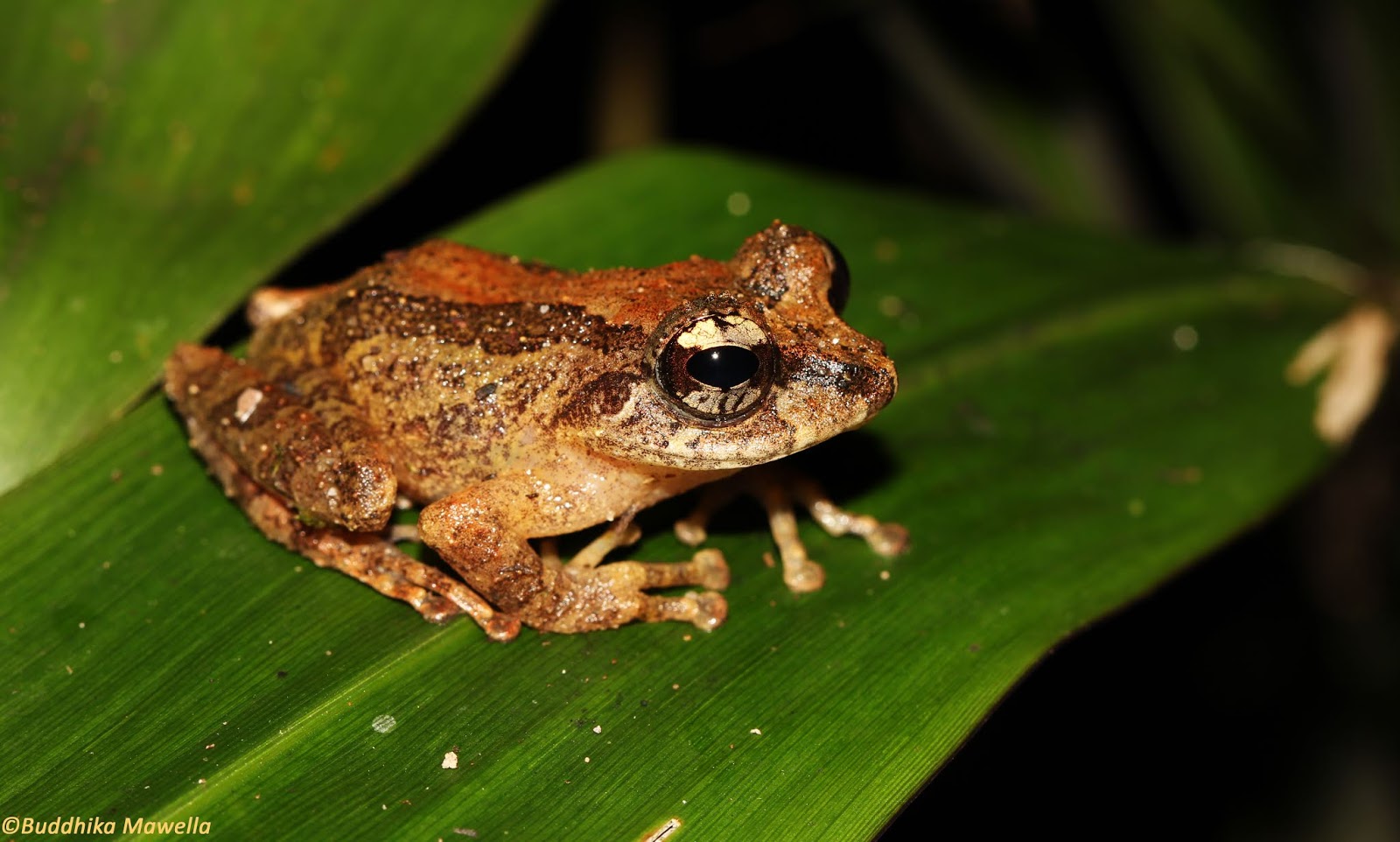
Pseudophilautus jagathgunawardanai

Pseudophilautus jagathgunawardanai (ජගත් ගුනවර්දනගේ පදුරැ මැඩියා) is an endemic species of shrub frog restricted to the Sripada Peak.

Monday, April 13, 2020

Handapan ella shrub frog (Pseudophilautus lunatus)

English: Handapan ella shrub frog
Sinhala: හඳපාන් ඇල්ල පැදුරු මැඩියා[Handapan ella panduru madiya]
Binomial: Pseudophilautus lunatus 

Pseudophilautus lunatus was first described in 2005 using a specimen found in Hadapan Ella near Suriyakanda in the Eastern Sinharaja area. Species name ‘Lunatus’ has the meaning of ‘Moon’. The species-epithet lunatus derives from Lunar which is a Latin word for moon. That word alludes to the type locality (‘Handapan Ella’ = moonlit waterfall). In their research paper, the first two observers, Kelum Manamendra Arachchi and Rohan Pethiyagoda, have mentioned that the endemic P. lunatus specimen was first observed in a cloud forest at an elevation of 1270 m above the sea level. So this amphibian which is geographically confined to a very small area, can be considered as a species with a higher possibility of extinction.

Saturday, March 21, 2020

Dilmah shrub frog (Pseudophilautus dilmah)

English: Dumbara corrugated frog
Sinhala: ඩිල්මා පදුරු මැඩියා[Dilmah panduru madiya]
Binomial: Pseudophilautus dilmah

Lulkandura Estate, known as the first tea plantation of Sri Lanka was first established by Mr. James Taylor in 1867. Even though most of the natural forests in the Loolkandura were cut down for early tea cultivation long time ago, only a small portion of the original cover still exists. Small frog in below photos was first described from the same area Loolkandura by a team of researchers led by Mr. Mendis Wickramasinghe in 2015. Population of them has only been restricted to the remaining natural forest patches of Loolkadura. Also the newly discovered frog was given the name Dilmah shrub frog (Pseudophilautus dilmah, ඩිල්මා පදුරු මැඩියා). The species has been named after Dilmah, which is a world renowned Sri Lankan tea exporting company who has contributed to the research. The fragmentation of forests and the global warming can be considered as threats for this rare frog.
Reference:
Wickramasinghe, Mendis; Bandara, Imesh Nuwan; Vidanapathirana, Dulan Ranga; Tennakoon,Kamani; Samarakoon,Sameera; Wickramasinghe, Nethu (26 April 2015). "Pseudophilautus dilmah, a new species of shrub frog (Amphibia: Anura: Rhacophoridae) from a threatened habitat Loolkandura in Sri Lanka".

Saturday, June 3, 2017

Knuckles Shrub Frog (Pseudophilautus fulvus)


English: Knuckles Shrub Frog
Binomial: Pseudophilautus fulvus
Sinhala: දුම්බර පඳුරු මැඩියා

Pseudophilautus fulvus is an endemic species of shrub frogs restricted to the Knuckles mountain region. It has been observed in closed canopy forests, anthropogenic habitats, secondary forests and cardamom plantations(Meegaskumbura and Manamendra-Arachchi 2005).
Above photographed ones were observed in the adjoining forest of Deanston Conservation Center in the knuckles region. The major threats for the species are habitat destruction and agro-chemical pollution. IUCN Red List status of the frog is ‘Endangered’

References: 
  • Manamendra-Arachchi, K., and Pethiyagoda, R. (2005). ''The Sri Lankan shrub-frogs of the genus Philautus Gistel, 1848 (Ranidae: Rhacophorinae), with description of 27 new species.'' Raffles Bulletin of Zoology, Supplement 12, 163-303.
  • The IUCN Red List of Threatened Species(tm) 2015-4 - http://www.iucnredlist.org
  • Manamendra-Arachchi, K. & R. Pethiyagoda (2006): Sri Lankan amphibians [in Sinhala]. – WHT Publications, Colombo.

Sunday, February 26, 2017

Mittermeier's shrub frog (Pseudophilautus mittermeieri)

English: Mittermeier's shrub frog
Binomial: Pseudophilautus mittermeieri
Sinhala: මිටර්මයර්ගේ පඳුරු මැඩියා

Mittermeier's shrub frog is an endemic species of shrub frogs restricted to the lowland wet zone of Sri Lanka. According to the original description, they have been observed in Kottawa and Beraliya Forest, in Elpitiya at the elevation levels of 60m and 150m. This species is morphologically more similar to Pseudophilautus decoris and phylogenetic analysis also shows that they are more related. But the population of P. decoris has been restricted to the Rakwana mountains with a higher elevation level compared to the habitat of Pseudophilautus mittermeieri(Meegaskumbura and Manamendra-Arachchi 2005). 
Above photographed ones were observed in Gilimale and Makandawa (Kithulgala) wet zone rain forests that fall in to the same elevation range(60m-150m). They were observed on shrubs of the closed forest. IUCN red list status of the species is endangered (EN).

Referances:
  • Meegaskumbura, Madhava, and Kelum Manamendra-Arachchi 2005 Description of Eight New Species of Shrub Frogs (Ranidae: Rhacophorinae: Philautus) from Sri Lanka. The Raffles Bulletin of Zoology 12: 305–338.
  • The IUCN Red List of Threatened Species(tm) 2015-4 - http://www.iucnredlist.org
  • Manamendra-Arachchi, K. & R. Pethiyagoda (2006): Sri Lankan amphibians [in Sinhala]. – WHT Publications, Colombo

Friday, January 6, 2017

Stuart's shrub frog ( Pseudophilautus stuarti)

Color of this one has been changed to match with the leaf litter.
English: Stuart's shrub frog
Binomial: Pseudophilautus stuarti
Sinhala: ස්ටුවර්ට්ගේ පඳුරු මැඩියා

Philautus stuarti is an endemic species of amphibian restricted to the knuckles region of Sri Lanka. This species was first described from the Coberts Gap region of knuckles by Dr. Meegaskumbura and Mr. Kelum Manamendra-Archchi in 2005. Elevation above the sea level of their observed location was about 1245m (Meegaskumbura and Manamendra-Arachchi 2005).

This species occurs in cloud forests with a good canopy cover. There is a similar species of amphibian which lives in the same knuckles region, namely Pseudophilautus mooreorum with the same body color. But P. stuarti can be easily distinguished from P. mooreorum by the prominent supratympanic fold and sharp cathal edge.
In addition to that, a population of shrub frogs named Pseudophilautus viridis which is morphologically more similar to P. stuarti occurs in the central highlands of Sri Lanka. Phylogenetic analyses have revealed that these both species are genetically more related to each other. These two populations have been geographically separated by Mahaweli River valley that separates central hills from the knuckles mountain region(Meegaskumbura and Manamendra-Arachchi 2005). It is believed that this long term geographical separation has led to common ancestor species of frogs to divide into two geographical groups and then to evolve them as two new separate species namely P. viridis and P. stuarti.

Above photographed ones were also observed in the adjoining forest of Deanston Conservation Center in the knuckles region which is about 4 km away from the Coberts Gap. Observed location was at a height of about 1320m above the sea level. We can believe that the reminding conserved forest segments of knuckles region provides some protection for the species. But due to the limited distribution, it falls in to the category of ‘Endangered’ in the IUCN Red List.

Referances:
  • Meegaskumbura, Madhava, and Kelum Manamendra-Arachchi 2005 Description of Eight New Species of Shrub Frogs (Ranidae: Rhacophorinae: Philautus) from Sri Lanka. The Raffles Bulletin of Zoology 12: 305–338.
  • The IUCN Red List of Threatened Species(tm) 2015-4 - http://www.iucnredlist.org
  • Manamendra-Arachchi, K. & R. Pethiyagoda (2006): Sri Lankan amphibians [in Sinhala]. – WHT Publications, Colombo

Saturday, November 5, 2016

Bigfoot shrub frogs (Pseudophilautus macropus)


English: Bigfoot shrub frogs
Binomial: Pseudophilautus macropus
Sinhala: විශාල පාදැති පඳුරු මැඩියා [Wishala padathi panduru madiya]

Pseudophilautus macropus is an endemic species of shrug frogs restricted to the Knuckles region of Sri Lanka. This frog is normally found near the streams and on wet rock surfaces. It is morphologically more similar to Pseudophilautus sarasinorum. Due to the limited habitat distribution, it is in the category of  'Critically Endagered'.

References: 
  • The IUCN Red List of Threatened Species(tm) 2015-4 - http://www.iucnredlist.org 
  • Manamendra-Arachchi, K. & R. Pethiyagoda (2006): Sri Lankan amphibians [in Sinhala]. – WHT Publications, Colombo.

Sunday, July 24, 2016

Cheeky shrub frog (Philautus procax)

Juvenile

English: Cheeky shrub frog
Binomial: Philautus procax
Sinhala: කම්මුලේ පැල්ලමැති පඳුරු මැඩියා[Kammule pallamathi panduru madiya]

Philautus procax is an endemic species of shrub frogs found in Sri Lankan highlands. The known population of this frog is restricted to the Rakwana Hills of the Eastern Sinharaja. Bearing a white patch between lower margin of the eye and the upper lip is a distinctive character which is the easiest identification method from other amphibians found in the same region. In the described research paper (Manamendra-Arachchi and Pethiyagoda 2005), they have mentioned that the holotype of the species was found in the elevation of 1060m at Morningside Forest Reserve. Above photographed ones were also found in Sooriyakanda area where the elevation is about 1080m above the sea level. Observed place was a closed-canopy cloud forest and there was a small water stream close to the perched shrubs. It is ‘Critically Endangered’ In the IUCN Red List and any activity that changes the environmental conditions of cloud forests might be a threat for the species.

References:
  • Manamendra-Arachchi, K., and Pethiyagoda, R. (2005). ''The Sri Lankan shrub-frogs of the genus Philautus Gistel, 1848 (Ranidae: Rhacophorinae), with description of 27 new species.'' Raffles Bulletin of Zoology, Supplement 12, 163-303.
  • The IUCN Red List of Threatened Species(tm) 2015-4 - http://www.iucnredlist.org 
  • Manamendra-Arachchi, K. & R. Pethiyagoda (2006): Sri Lankan amphibians [in Sinhala]. – WHT Publications, Colombo.

Saturday, June 25, 2016

Sri Lanka Petite Shrub-frog (Pseudophilautus tanu)


English: Sri Lanka Petite Shrub-frog
Binomial: Pseudophilautus tanu

Sri Lanka Petite Shrub-frog is an endemic species of amphibians found in the law-land wet zone forests of Sri Lanka. It can be observed in open areas of canopy covered forest margins. In the research paper (PETHIYAGODA 2009) they have mentioned that this species was observed in Kanneliya and Pituwela rain forests. In addition to that it has been mentioned that the species might occur in other lowland wet zone forests of the island. It is believed that this species also lay eggs in the soil, which is the common egg laying behavior of the genus Pseudophilautus.
Above photographs were taken at Gilimale rain forest, Rathnapura. Photographed location was a forest margin and there were small water streams closed to the fern trees which we found above specimen. Any human activity that change the environmental consistency of forest margins such as adding garbage and agricultural activities can be considered as the main threats for the species. IUCN Red list status of this frog is 'Endangered'.

Referance:
  • PETHIYAGODA, ROHAN 2009 Two New Species of Shrub Frogs (Rhacophoridae: Philautus) from the Lowlands of Sri Lanka. Zootaxa 2122: 51–68.
  • The IUCN Red List of Threatened Species(tm) 2015-4 - http://www.iucnredlist.org

Sunday, June 5, 2016

Sri Lanka Short-Horned Shrub frog (Pseudophilautus singu)


English: Sri Lanka Short-Horned Shrub frog
Binomial: Pseudophilautus singu 

Pseudophilautus singu is an endemic species of frogs found in the wet zone of Sri Lanka. This species was described scientifically in 2009 for the first time. Bearing horn like tubercles on the upper eyelids caused to have the species name “Singu” which has the Sinhala meaning “Horn”. In the research paper, they (PETHIYAGODA 2009) have observed this frog in Kithulgala and Kottawa rain forests. In addition to that I observed the same species in Kalugala rain forest, Baduraliya. Observed habitat of this frog was very wet and had a good forest cover. Also there were some small water streams close to the perched shrubs. It has been categorized as ‘Endangered’ In the IUCN Red Red List,

Referances: 
  • PETHIYAGODA, ROHAN. 2009. “Two New Species of Shrub Frogs (Rhacophoridae: Philautus) from the Lowlands of Sri Lanka.” Zootaxa 2122: 51–68. 
  • The IUCN Red List of Threatened Species(tm) 2015-4 - http://www.iucnredlist.org

Sunday, May 15, 2016

Golden shrub frog (Pseudophilautus auratus)

English: Golden shrub frog
Binomial: Pseudophilautus auratus
Sinhala: රන්වන් පඳුරු මැඩියා [Ranwan panduru madiya]

Pseudophilautus auratus is an endemic species shrub frogs restricted to the wet zone forests of Sri Lanka. It is considered to be rare and commonly seen in higher elevations (513-1270m) of Sinharaja world heritage site, such as Morningside and Sooriyakanda forest reserves. Color of the body is highly variable and can be seen in yellow, pink or brownish pink. Latin species name “auratus” is an allusion to the golden skin color. Breeding of this amphibian does not depend on water and it takes place by direct development. IUCN Red List status of this frog is “Endangered”. Deforestation and agricultural activities are said to be the main threats.

References:
  • Manamendra-Arachchi, K., and Pethiyagoda, R. (2005). ''The Sri Lankan shrub-frogs of the genus Philautus Gistel, 1848 (Ranidae: Rhacophorinae), with description of 27 new species.'' Raffles Bulletin of Zoology, Supplement 12, 163-303. 
  • The IUCN Red List of Threatened Species(tm) 2015-4 - http://www.iucnredlist.org 
  • Manamendra-Arachchi, K. & R. Pethiyagoda (2006): Sri Lankan amphibians [in Sinhala]. – WHT Publications, Colombo.

Saturday, April 2, 2016

Golden-eyed shrub frog (Pseudophilautus ocularis)


English: Golden-eyed shrub frog
Binomial: Pseudophilautus ocularis
Sinhala: රන්වන් ඇස් ඇති පඳුරු මැඩියා[Ranwan as athi panduru madiya]

Pseudophilautus ocularis is an endemic species of shrub frogs restricted to the cloud forests of Rakwana mountain range of Sri Lanka. Lives only in covered forests and close to forest margins. Above photographed frogs were found in Sooriyakanda area where elevation above the sea level ranges from 1080m to 1160m. Having gold colored eyes is an attractive feature of this species and that caused to have the Latin specie name "ocularis" with the meaning of "of the eyes". In IUCN red list, this species has been rated as 'Critically Endangered' due to its limited distribution that is only in higher altitudes of Rakwana mountains. Habitat loss is considered as the main threat for the existence of this species.

References:
  • Manamendra-Arachchi, K., and Pethiyagoda, R. (2005). ''The Sri Lankan shrub-frogs of the genus Philautus Gistel, 1848 (Ranidae: Rhacophorinae), with description of 27 new species.'' Raffles Bulletin of Zoology, Supplement 12, 163-303.
  • The IUCN Red List of Threatened Species(tm) 2015-4 - http://www.iucnredlist.org
  • Manamendra-Arachchi, K. & R. Pethiyagoda (2006): Sri Lankan amphibians [in Sinhala]. – WHT Publications, Colombo.

Friday, March 4, 2016

Kandyan Shrub Frog (Pseudophilautus rus)


English: Kandyan Shrub Frog
Binomial: Pseudophilautus rus
Sinhala: නුවර පඳුරු මැඩියා[Nuwara panduru madiya]

Pseudophilautus rus is an endemic species of frog found in wet zone of Sri Lanka. Lives many in wet zone forests and also close to human habitats. It was first described from Kandy district that caused the name 'Kandyan Shrub frog'. IUCN Red List status is 'Near Threatened'. Habitat loss and agrochemicals are considered to be the main treats for the existence of this species. 

References: Manamendra-Arachchi, K., and Pethiyagoda, R. (2005). ''The Sri Lankan shrub-frogs of the genus Philautus Gistel, 1848 (Ranidae: Rhacophorinae), with description of 27 new species.'' Raffles Bulletin of Zoology, Supplement 12, 163-303.
Sri Lankawe Ubhayajeeven - Rohan Pethiyagoda/Kelum Manamendra-arachchi.

Saturday, February 13, 2016

Hollow-snouted srub frog (Pseudophilautus cavirostris)


English: Hollow-snouted srub frog
Binomial: Pseudophilautus cavirostris
Sinhala: හිරිගඩු පඳුරු මැඩියා[Hirigadu panduru madiya]

Pseudophilautus cavirostris is an endemic species of shrub frog restricted to the wet zone rain forests where there is a good canopy cover. Mostly lives on mossy leaves of trees, stems and wet rock surfaces. Well camouflaged body makes it difficult to identify at once for their predators. physique is similar to Pseudophilautus schmarda and to Pseudophilautus decoris who's distribution is restricted to the central highlands and to the Rakwana highlands respectively. But the population of p.cavirostris has been extended to lowland rain forests also. IUCN Red List status of this frog is 'Endangered'. Habitat loss and agro-chemicals are considered to be the main threats for the existence of this frog.

Reference: Sri Lankawe Ubhayajeeven - Rohan Pethiyagoda/Kelum Manamendra-arachchi