Thursday, October 1, 2020

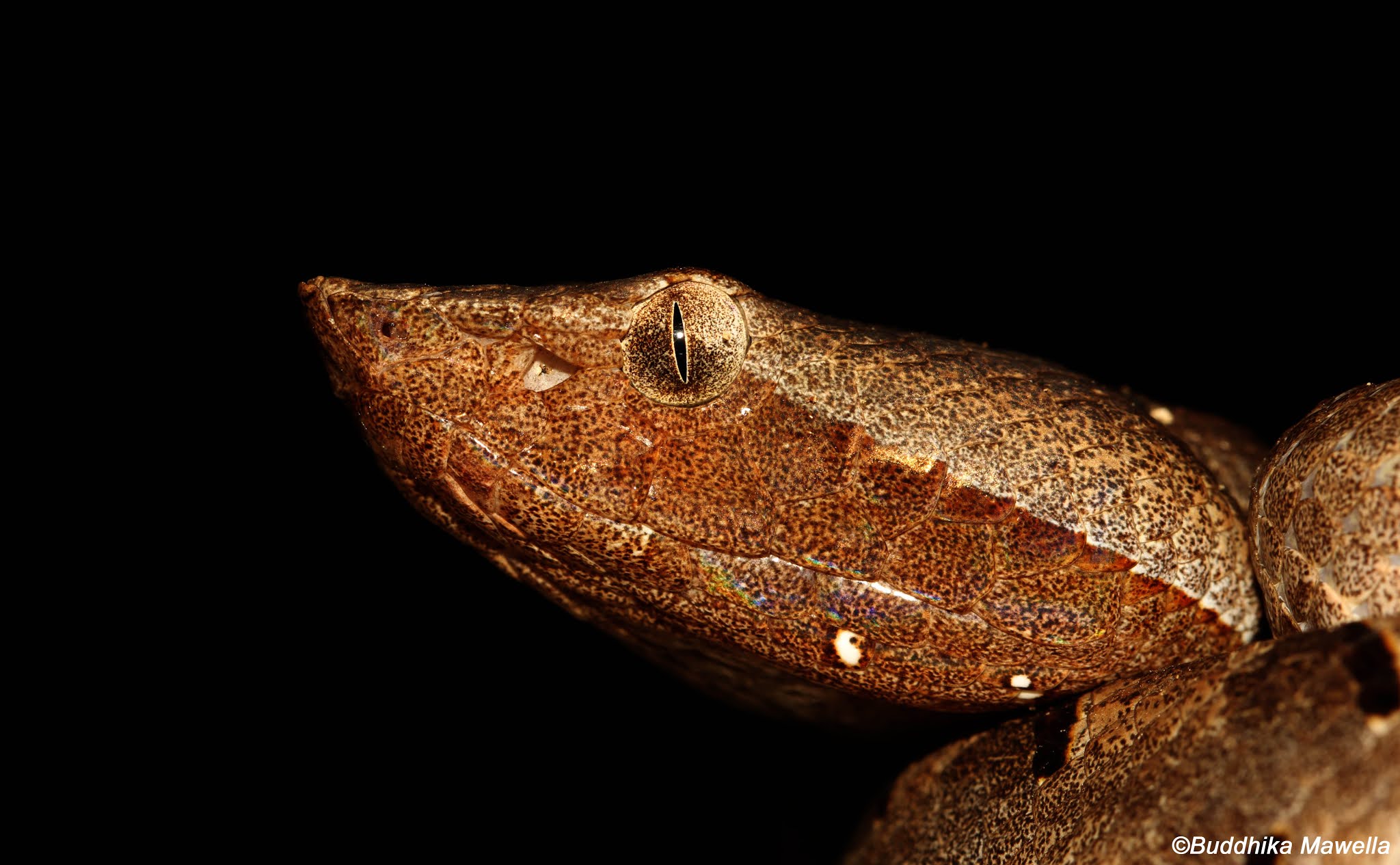
Merrem's hump-nosed viper (Hypnale hypnale)

English: Merrem's hump-nosed viper
Sinhala: කුණකටුවා / පොලොන් තෙලිස්සා [Kunakatuwua/Polon thelissa]
Binomial name: Hypnale hypnale

Hypnale hypnale (Merrem's hump-nosed viper) is a venomous pit viper species found in Sri Lanka and India. Based on the taxonomic revisions done so far, have stated that there are four species that belong to the genus Hypnale which live in Sri Lanka (Including possibly new species Hypnale sp. ‘amal’). Among them, population of H. hypnale in Sri Lanka has been observed mainly in anthropogenic habitats and no observations have been made in undisturbed forests (Maduwage et al. 2009). At a glance, morphologically all these four species look similar. But with a closer look, H. hypnale can be easily distinguished from its congeners using scalation and with the help of non raised snout tip. This species is more active at night and in the day time they live under the logs, rocks and in the leaf litter. Venom of this genus mainly causes local envenoming, coagulopathy, acute renal failure and death. A research done by Dr. Anjana Silva and others (Silva et al. 2012) to compare the in-vivo toxicity of venoms of this genus reveals that the venom of H. hypnale has the highest toxicity compared to the venom of H. zara and H. nepa, with the LD50 value of 1.6 μg protein/g. Since there are known human bite reports with serious complications, this snake has been placed in the category of ‘Medically important’. 

Ref: Silva, Anjana, Panduka Gunawardena, Danister Weilgama, Kalana Maduwage, and Indika Gawarammana 2012 Comparative in-Vivo Toxicity of Venoms from South Asian Hump-Nosed Pit Vipers (Viperidae: Crotalinae: Hypnale). BMC Research Notes 5(1): 471. 

Maduwage, Kalana, Anjana Silva, Kelum Manamendra-Arachchi, and Rohan Pethiyagoda 2009 A Taxonomic Revision of the South Asian Hump-Nosed Pit Vipers (Squamata: Viperidae: Hypnale). Zootaxa 2232: 1–28. 
Maduwage K, Kularatne K, Wazil A, Gawarammana I: Coagulopthy, acute kidney injury and death following Hypnale zara envenoming – The first case report from Sri Lanka. Toxicon 2011, 58:641–643

Saturday, May 23, 2020

Rohan’s Globular Frog (Uperodon rohani)

English: Rohan’s Globular Frog
Sinhala: රොහාන්ගේ මොට හොඹු මැඩියා[Rohange motahombu madiya]
Binomial: Uperodon rohani
Taxonomic revision done in the genus Uperadon describes that previously known amphibian Uperodon variegatus of Sri Lanka as a new species and it was named as Uperadon rohani. Also it is said that this species is endemic to Sri Lanka. Species name ‘rohani’ has been used in honor of Mr. Rohan pethiyagoda, who is a popular naturalist in the country. Uperadon rohani differs from its close Indian relative Uperadon variegatus by a set of morphological characters. In addition to the morphology, genetic studies done in the research based on 16S mitochondrial RNA also proves the same.

Monday, April 13, 2020

Handapan ella shrub frog (Pseudophilautus lunatus)

English: Handapan ella shrub frog
Sinhala: හඳපාන් ඇල්ල පැදුරු මැඩියා[Handapan ella panduru madiya]
Binomial: Pseudophilautus lunatus 

Pseudophilautus lunatus was first described in 2005 using a specimen found in Hadapan Ella near Suriyakanda in the Eastern Sinharaja area. Species name ‘Lunatus’ has the meaning of ‘Moon’. The species-epithet lunatus derives from Lunar which is a Latin word for moon. That word alludes to the type locality (‘Handapan Ella’ = moonlit waterfall). In their research paper, the first two observers, Kelum Manamendra Arachchi and Rohan Pethiyagoda, have mentioned that the endemic P. lunatus specimen was first observed in a cloud forest at an elevation of 1270 m above the sea level. So this amphibian which is geographically confined to a very small area, can be considered as a species with a higher possibility of extinction.

Saturday, March 21, 2020

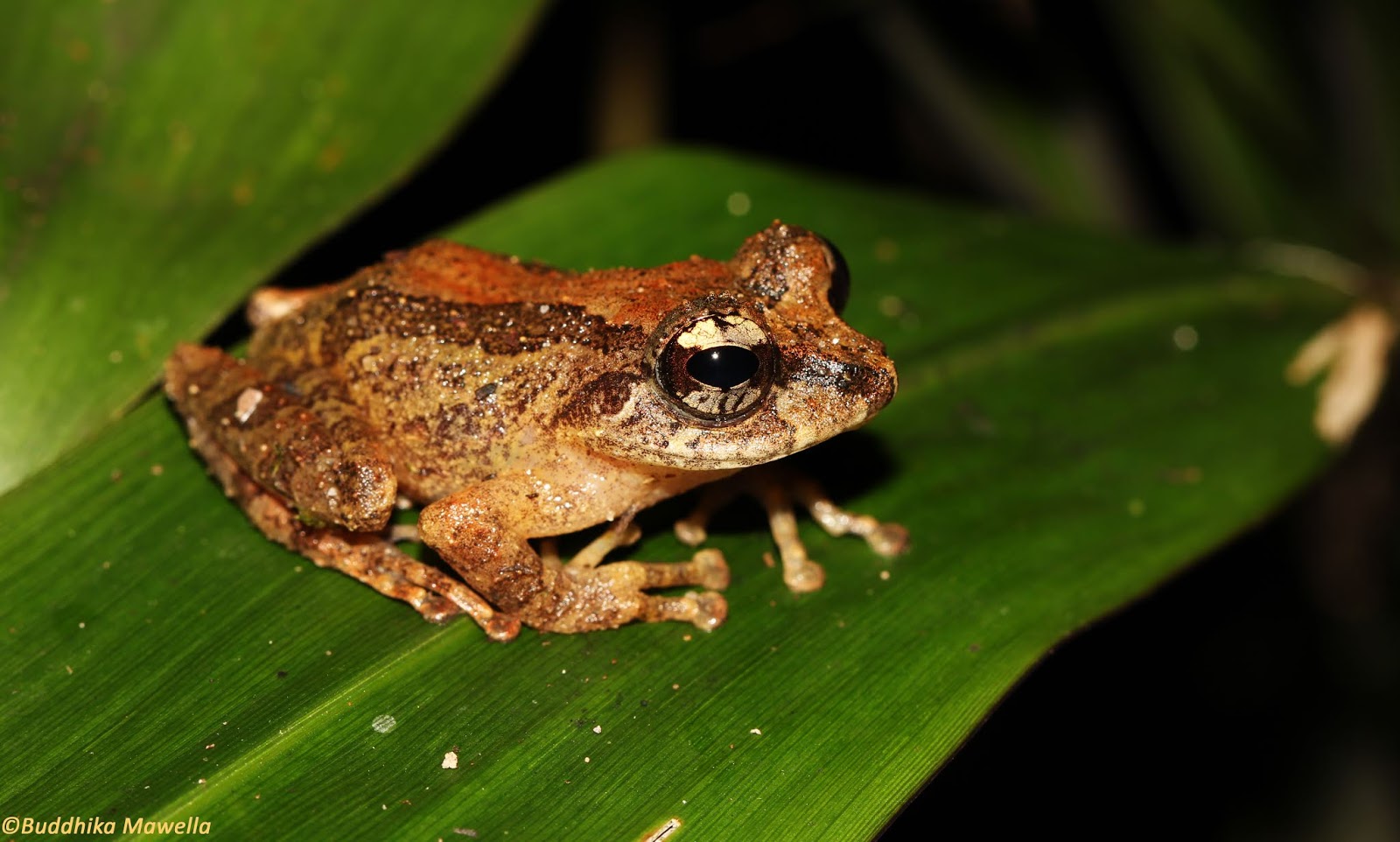
Dilmah shrub frog (Pseudophilautus dilmah)

English: Dumbara corrugated frog
Sinhala: ඩිල්මා පදුරු මැඩියා[Dilmah panduru madiya]
Binomial: Pseudophilautus dilmah

Lulkandura Estate, known as the first tea plantation of Sri Lanka was first established by Mr. James Taylor in 1867. Even though most of the natural forests in the Loolkandura were cut down for early tea cultivation long time ago, only a small portion of the original cover still exists. Small frog in below photos was first described from the same area Loolkandura by a team of researchers led by Mr. Mendis Wickramasinghe in 2015. Population of them has only been restricted to the remaining natural forest patches of Loolkadura. Also the newly discovered frog was given the name Dilmah shrub frog (Pseudophilautus dilmah, ඩිල්මා පදුරු මැඩියා). The species has been named after Dilmah, which is a world renowned Sri Lankan tea exporting company who has contributed to the research. The fragmentation of forests and the global warming can be considered as threats for this rare frog.
Reference:
Wickramasinghe, Mendis; Bandara, Imesh Nuwan; Vidanapathirana, Dulan Ranga; Tennakoon,Kamani; Samarakoon,Sameera; Wickramasinghe, Nethu (26 April 2015). "Pseudophilautus dilmah, a new species of shrub frog (Amphibia: Anura: Rhacophoridae) from a threatened habitat Loolkandura in Sri Lanka".

Sunday, March 8, 2020

Temnophylloides astridula

Binomial name: Temnophylloides astridula
Temnophylloides astridula is a leaf mimicking katydid resides in lowland wet zone. Genus Temnophylloides is monotypic and endemic to Sri Lanka. Family which this katydid belongs to has been diversified from others about 200-150 million years ago in the jurassic.

Sunday, August 25, 2019

Dumbara corrugated frog (Lankanectes pera)

English: Dumbara corrugated frog
Sinhala: දුම්බර වකරැලි මැඩියා [Dumbara wakareli madiya]
Binomial: Lankanectes pera
For more than 150 years, it was believed that the genus Lankanectes is monotypic and the genus consists of a one species named, Lankanectes corrugatus. But later, a group of researchers observed an amphibian in Knuckles mountains that was very similar to previously known L. corrugatus, but having some morphological differences. 
Finally in 2018, they have described the Lankanectes population resides in the knuckles mountain range as a new species by giving the name, Lankanectes pera. Species was named after University of Peradeniya and the name 'Pera' is a short form of the name for University of Peradeniya which is being used by many university students. 
Genetic studies have also been carried out to compare genetic differences between L. corrugatus and the knuckles population of Lankanectes. Results from DNA barcoding and phylogenetic analyses have shown that L. pera differs from L. corrugates by 3.5−3.7% uncorrected genetic distances for 16S rRNA, which is adequate to name the knuckles population as a separate species. Based on the study, they have concluded that the new species defers from L. corrugates in external morphology, genetics and climatic niche. 
Distribution of L. pera is very limited and they have been restricted to higher altitude streams flowing through the montane forests in the Knuckles region where elevation is about 1100m above the sea level. Also, the environments they live have already been threatened by human activities. Hence, some immediate conservation actions must be taken to protect this rare frog.
Referance:
Senevirathne, Gayani & Samarawickrama, Pradeep & Wijayathilaka, Nayana & Manameendraarchchi, Kelum & Samarawikrama, DRNS & Meegaskumbura, Madhava. (2018). A new frog species from rapidly dwindling cloud forest streams of Sri Lanka—Lankanectes pera (Anura, Nyctibatrachidae). Zootaxa. 4461. 519-538. 10.11646/zootaxa.4461.4.4.

Sunday, June 9, 2019

Mihintale Red Narrow-mouthed Frog (Microhyla mihintalei)

English: Mihintale Red Narrow-mouthed Frog
Sinhala: මිහින්තලය රතු මුව පටු මැඩියා [Mihinthalaya rathu muwa-patu madiya]
Binomial: Microhyla mihintalei

Mihintale Red Narrow-mouthed Frog(Microhyla mihintalei) is an endemic frog and it was described recently (2016) with the help of specimens collected from dry zone of Sri Lanka including Mihinthale. The species was named after Mihintale which is one of the world’s earliest documented sanctuaries. It is also known as the place where King Dewanampiya Tissa met Mihindu thero who came from India in 246 BC.
But the ancestors of Microhyla mihintalei have found their way to Sri Lankan lowlands from India few million years ago via the land bridge created between Sri Lanka and India which was caused by earlier ice ages followed by excessive ice deposits in poles. But later, rise in the sea level caused land mass between India and Sri Lanka to disappear by creating an oceanic barrier and that resulted closing the land connection between two lands.
In India, Still lives a frog named Microhyla rubra, who is considered to be a descendent of the common ancestor of Microhyla mihintalei. As a result of thousands of years of separation due to the oceanic barrier between two land masses, Sri Lankan population of this common frog has been evolved as the new species we call, Microhyla mihintalei.
Studies have suggested significant genetic distance, morphology and differences in vocalization to distinguish Microhyla mihintalei from its common Indian ancestral species, Microhyla rubra.

Reference:
Meegaskumbura, Madhava; Biju, S. D.; Karunarathna, Nuwan; Senevirathne, Gayani; Garg, Sonali; Wijayathilaka, Nayana (2016). "A new species of Microhyla (Anura: Microhylidae) from Sri Lanka: an integrative taxonomic approach". Zootaxa. 4066 (3): 331–342. doi:10.11646/zootaxa.4066.3.9